

AI in Healthcare: What Is Safe to Automate
In most sectors the first question about AI is what it saves. In healthcare it is what happens when it is wrong. This page covers the eight use cases hospitals ask us about. It also covers four agents that take admin load off clinical staff, and an honest account of where each one carries risk.
20 min read
Indian hospitals record a great deal each day, and very little of it connects. A mid-sized multi-speciality hospital runs a HIS for admissions and billing. Pathology sits in a separate LIS, imaging in a PACS. Discharge summaries are dictated or typed into a third system, while insurance letters live in email. Each one is fine on its own. None of them talk to each other, and the gaps swallow staff hours.
That gap matters more here than in most sectors. The people who absorb it are clinical. A doctor spends forty minutes a day on notes. A nurse chases a pre-auth, and a coder re-reads a discharge summary to find a diagnosis already written down. Those are skilled hours spent on typing. The strongest case for AI in a hospital in India is seldom diagnostic; it is giving clinical hours back to clinical work.
The eight below run from admin work to clinical work. That is also the order of rising risk and falling ease. Most hospitals should start at the admin end and earn their way toward the clinical one.
Sequencing
The Order That Works
Each rung earns the trust and the data plumbing the next one needs. Jumping straight to the clinical end is how most of these programmes stall.
- 1
Start where no clinical judgement applies
Claims, coding, pre-auth. Errors cost rework, not harm. No one has to approve a change to clinical practice. The finance team can see the result within a quarter, which is what buys you the credit for anything more.
- 2
Move to scheduling and flow
Theatre lists, bed allocation, appointment slots. Still admin work. But it now touches how clinicians spend their day, so they must set the constraints with you. Get this wrong and you have a list no one follows.
- 3
Then documentation support
Drafting notes and summaries for clinician review. This is the first point where output touches the record, so accountability must be explicit. The clinician signs. The draft is never the record. Most of the time saving on this list lives here.
- 4
Only then anything clinical-adjacent
Triage support, readmission risk, image prioritisation. These need governance, an audit trail, and a named clinical owner who can defend the model in a review. Try this first and you will spend six months in committee before writing any code.
The Eight
What Each One Actually Does
Admin first, clinical last. For each one: what it does, what it needs from your systems, and where the risk sits.

Medical Coding Automation
The diagnosis was already written down. A person is paid to find it again.
Coding means reading a discharge summary and turning it into ICD and procedure codes. Each fact is there in the file. The work is finding it, mapping it to the right code, and staying consistent. That work is precise, repetitive and well suited to automation.
A model reads the notes and proposes the ICD and procedure codes, with the text behind each one marked. The coder then sees why a code was suggested, rather than a bare list. They confirm, correct or reject it, and those corrections become training data. Accuracy on your own notes then improves over months.
Start here because errors are cheap, easy to spot and non-clinical. A wrong code is caught in audit or query, costs a resubmission, and harms no one. That makes it the safest place for a hospital to learn how working with a model feels.
What it needs
- Discharge summaries and operative notes as text. Scanned images need OCR first, which adds weeks.
- Your past coded records, which are the training labels.
- The code sets you bill against, including any payer-specific ones.
- A coder willing to correct, not just accept. Passive acceptance teaches the model nothing.
Claims Processing
Extract, validate, and route only the exceptions to a person.
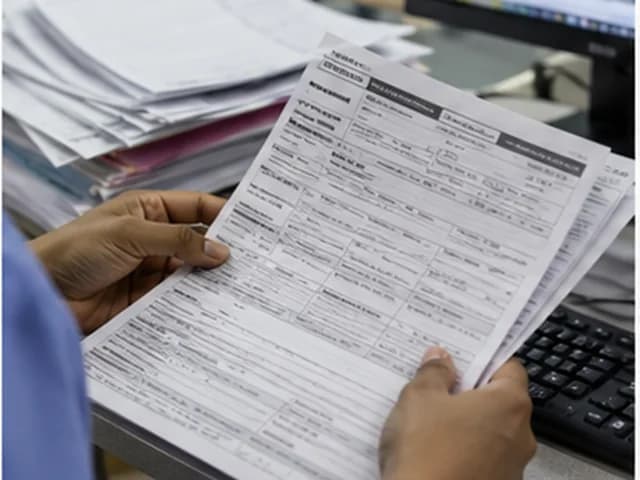
Insurance claims come in and go out as papers: pre-auth forms, discharge summaries, itemised bills, query letters. Staff spend the day re-keying between formats, and checking that what was claimed matches what was written down. Most claims are routine. The trouble is that finding the routine ones takes as long as handling the hard ones.
Extraction turns each file into structured fields, checks them against policy terms and the record, and separates clean claims from the ones needing a look. A clean claim goes ahead. An exception goes to a person with the problem already named: this diagnosis is not backed by the notes, this item is over the policy sub-limit.
In India the real gain is often query turnaround, not first-pass approval. Insurer queries come in with a clock running. The delay is almost always the hours spent finding and pulling the papers together, rather than any dispute about the medicine.
Where the value is
- Query response time. Often the biggest lever on days in receivables.
- Rejections caused by missing papers, not by clinical disagreement.
- Consistency across TPAs. Each one wants its own pack.
- Watch for policy terms that change without notice, and kill your rules.
Appointment & Theatre Scheduling
Theatre time is the most expensive resource in the building, and the least well allocated.
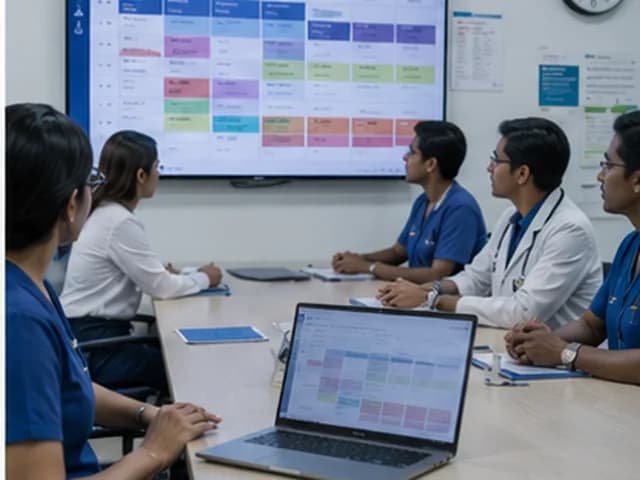
A theatre list is a constraint problem. Procedure times vary by surgeon and by how complex the case is. Staff and equipment have to be free together, emergencies interrupt, and some cases must follow others for infection-control reasons. Most hospitals solve this with a skilled coordinator and a whiteboard, which works until that person is on leave.
Most of the gain comes from using actual times rather than booked ones. Say a surgeon's hernia repairs always take seventy minutes and the list books ninety. The day runs early and the theatre sits idle. Book eighty and you fit another case a week. That is a scheduling change, not a clinical one.
Outpatient appointments have their own version of this: no-show risk. Predict which slots will go unused, and you can then overbook by a small, chosen amount. The other options are wasting slots, or overbooking everywhere and making patients wait.
Reality check
- Booked duration is not actual duration: model the actual one, or you have automated the current error.
- Model emergencies as interruptions, not as noise.
- Surgeon preference is a real constraint, and a list that ignores it gets overridden.
- The theatre coordinator must be involved from day one. Without that you get lists no one follows.

Clinical Note Summarisation
Forty minutes a day of a doctor's time, spent typing what they already said.
Notes take more doctor and nurse hours than any other task that is not care. Consultation notes, discharge summaries, referral letters: each one has to be written. Each is written by the most expensive person in the room. That often happens at the end of a long day, when attention is lowest.
Summarisation drafts these from material that already exists: the consultation record, test reports, drug history, earlier notes. The clinician reviews, edits and signs. One distinction matters most. The draft is never the record. The signed version is the record, and a clinician signs it.
Done well, this is the highest-value item on the list for most hospitals: it returns hours to the staff you have least of. Done carelessly it is the most dangerous, because a summary that reads well but drops one detail is harder to catch than an obviously wrong one. So the review step is not optional. We build the screen to make editing easy, not to make accepting easy.
Non-negotiables
- The clinician signs; the draft has no status until they do.
- Each generated claim traceable to its source in the record, so review is checking not re-reading.
- Editing must be as fast as accepting, or review becomes rubber-stamping.
- Never let the model add a fact that is not in the source material.
Patient Triage Assistance
Rank cases by acuity from symptoms and history, supporting clinical judgement and never replacing it.
In a busy casualty the order patients are seen in is decided fast. Often by a nurse, working from presenting complaint and appearance. Experienced triage is very good, but it varies from one nurse to the next. And it degrades under load, which is exactly when it matters most.
A support model scores incoming cases against recorded symptoms, vitals and history, and flags the ones that look like cases that later got worse. It does not assign a triage category, or override the nurse. It puts a second opinion in front of the nurse, most usefully for the patient who looks stable and was not.
This sits at the clinical end of the ladder by design. It needs a named clinical owner, an audit trail of each recommendation and what was done, and a governance process. Hospitals that try it first tend to stall in committee, while those coming with three working admin projects behind them tend to get approval.
Governance required
- A named clinician accountable for the model's behaviour in review.
- Full audit trail: what was recommended, what was done, what happened.
- Recommendations are advisory and clearly labelled, never a triage category.
- Regular review of the cases where the model and the nurse disagreed.

Readmission Risk Prediction
Spot who is likely to return, early enough that follow-up changes the outcome.
Some readmissions cannot be avoided. Many follow a pattern: a patient sent home without a clear drug plan, one who lives far from follow-up care, one whose comorbidities make recovery fragile. The pattern is often there in the record on the day of discharge.
A model scores each patient on the day of discharge. It flags high risk, with the factors behind the score attached. The value comes from what happens next: a follow-up call on day three, a drug review, an earlier outpatient appointment. Without a defined intervention, this is a number that makes no one healthier.
That is the honest caveat. We have seen readmission models built and validated, and then achieve nothing. No one owned the follow-up. Agree what you will do with a high-risk flag before you build the model that raises one.
Decide first
- What intervention a flag triggers, and who carries it out.
- Which patients you can reach: a flag on a patient you cannot contact does nothing.
- How you will check that the intervention worked, not just that the score was right.
- Whether the data at discharge is complete enough at the moment the score is needed.
Drug Interaction Checking
Cross-check each prescription against history and known interactions, at the point of prescribing.
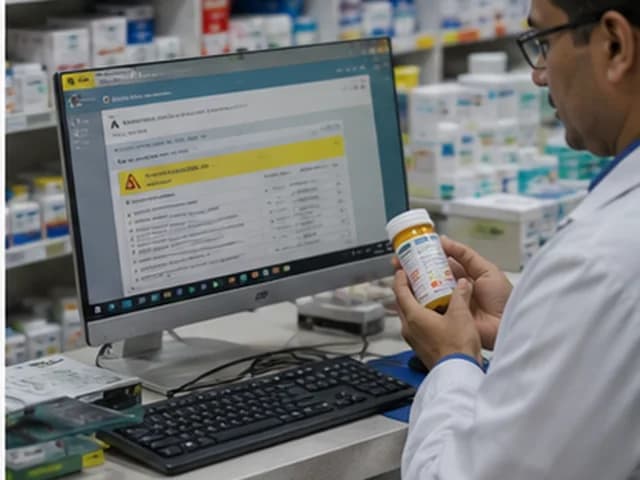
Interaction checking is well established, and most hospital systems have some form of it. The problem is rarely that it is missing; it is alert fatigue. A system that warns on each possible interaction trains prescribers to dismiss warnings without reading them. At that point it is worse than nothing: it gives false assurance.
The useful work is ranking: hold back the alerts of low relevance. Raise the ones that matter for this patient, given renal function, age, comorbidities and current drugs. A prescriber reads a warning when it fits the patient in front of them.
The ground here is well covered. So this is a tuning and integration job more than a modelling one, which makes it a fair first clinical-adjacent project. The risk is not the technology; it is setting thresholds without the pharmacy team. Do that and you get either noise or silence.
The real problem is fatigue
- Track the alert override rate. A high rate means the system is being ignored.
- Tune thresholds with the pharmacy team, not by optimising a statistic.
- Patient context matters more than the interaction list: renal function, age, comorbidities.
- Sound the alert where prescribing happens, not in a report read afterwards.

Medical Image Analysis
Prioritise the reading queue and offer a second look. The radiologist reports.
This is the use case that gets the press, and it is useful. Its value in an Indian hospital is often not the value in the headlines. It is seldom about spotting what a radiologist would miss. It is about the queue.
A model can flag studies that look like urgent findings, so those get read first. When reporting turnaround is measured in hours or days, moving one study to the front of that queue can matter more than a small accuracy gain on a single read. This is triage of the worklist, not replacement of the report.
The second use is a second look: a marker on a region for the radiologist to confirm or dismiss, with their verdict recorded. Both uses keep the radiologist as the reporting clinician. Any deployment that reduces or bypasses that role is a liability problem dressed up as technology. We will not build one.
What it takes
- PACS integration and a workflow the radiologist will use.
- Validation on YOUR patient population. Results published elsewhere rarely transfer unchanged.
- A clear position on regulatory status for the exact tool and indication.
- Radiologist time for validation, which is the scarcest input in the whole project.
Where We Specialise
Agents That Take Load Off Clinical Staff
Everything above gives an output that a person then acts on. In a hospital that person is usually clinical, and the acting is usually admin work: assembling a pre-auth packet, making follow-up calls, chasing a file. That is the load worth removing.
The four agents below do the gathering, drafting and chasing around clinical work. None of them makes a clinical decision, and none acts on anything consequential without a human approving it. Each is built so the clinician reviews rather than assembles.
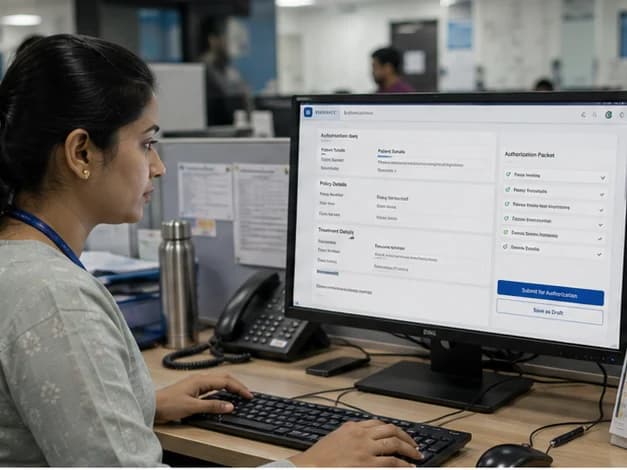
Prior Authorisation Agent
The pre-auth packet assembled and checked before anyone sits down to type it.
Pre-auth is where admissions stall. Each insurer and TPA wants its own set of papers, in its own form, and the requirements change without warning. A packet missing one investigation report comes back as a query two days later, with the patient still in the bed.
The agent builds the packet the moment a case is flagged for pre-auth. It pulls the diagnosis and the proposed procedure, then adds the test reports, the treating doctor's notes and the estimate, formatted the way that insurer wants. It then checks the packet against what that insurer has queried on similar cases before. Missing items are flagged while they are still easy to get.
A person submits it. The agent does the assembly and the checking, which is where the hours and the delays actually sit.
What it touches
- HIS for diagnosis, procedure and estimate.
- LIS and PACS for supporting investigation reports.
- Past queries by insurer. These are what make the completeness check accurate.
- The insurer or TPA portal, in draft. A person submits it.
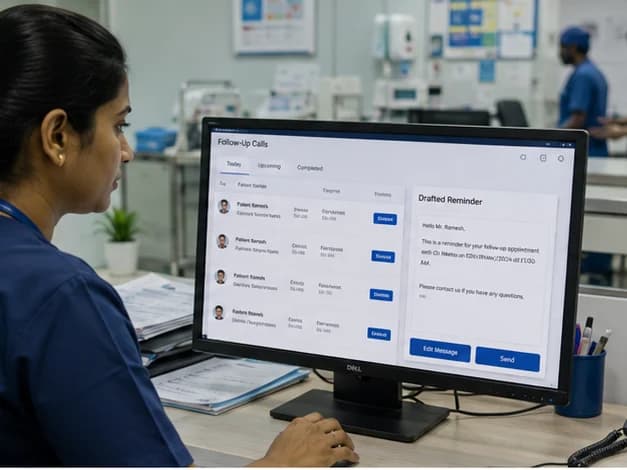
Patient Follow-Up Agent
The day-three call that all agree matters, and that no one has time to make.
Post-discharge follow-up is the one step most likely to prevent a readmission, and the one most often skipped. It competes for nursing hours against patients present in the ward. No one disagrees with it. It just always loses.
The agent keeps the follow-up schedule from the discharge instructions. It sends reminders for drugs and appointments in the patient's own language. It collects simple replies. It escalates the ones that need a person: a reported symptom, a missed dose, an appointment not booked. The nurse gets a short list of patients who really need a call that day. Not a list of everyone discharged this week.
It pairs well with readmission risk scoring. The model says who needs follow-up, and the agent performs it and raises only the exceptions.
Practical notes
- Language matters more than technology. Send reminders in the language the patient reads.
- Keep replies structured and simple. Free-text replies at scale need triage of their own.
- Escalation must reach a named person, not a shared inbox.
- Capture consent to contact, and the channel to use, at discharge.
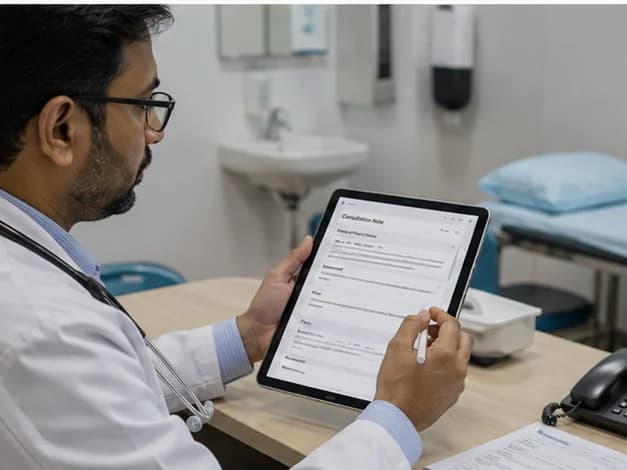
Clinical Documentation Agent
The discharge summary drafted from the record, waiting for the doctor to check and sign.
Summarisation writes text when you ask for it, while this agent watches the workflow. When a patient is marked for discharge it builds the summary from the admission note, progress notes, test reports, procedures and current drugs, in the hospital's own format. The draft lands in the doctor's queue before they ask for it.
It also chases what is missing. An unsigned operative note, a pending report, a drug list that does not match the last prescription. These are the things that hold a discharge up for hours. The patient waits in a bed you need.
The doctor reviews and signs. What changes is the starting point: they correct a draft built from the record, rather than rebuilding the admission from memory at seven in the evening.
Non-negotiables
- Nothing enters the record until a clinician signs it.
- Each statement traceable to its source note, so review is verification not reconstruction.
- Missing-item chasing is often worth more than the drafting itself.
- It must produce the hospital's current format. Not an improved one no one recognises.
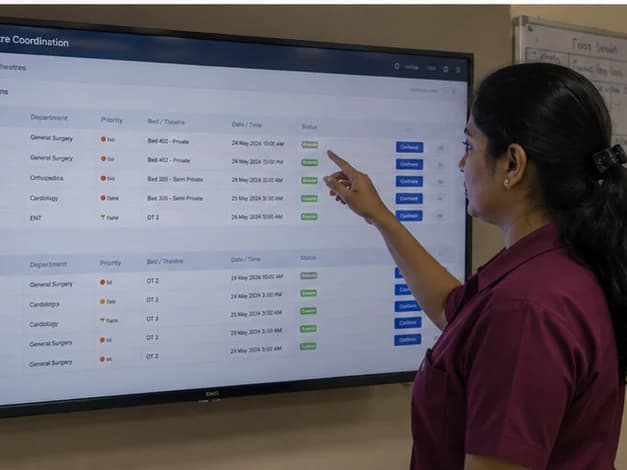
Bed & Theatre Coordination Agent
Beds and lists rebalanced through the day, so the coordinator decides instead of gathering facts.
Bed and theatre coordination is one long negotiation. A case overruns, an emergency arrives, a discharge waits on a report, a patient needs isolation. The coordinator holds all of it in their head and on a whiteboard. Most of the job is finding out what has changed.
The agent watches admissions, discharges, theatre progress and pending tests through the day. It keeps a current picture: which beds free up when, which lists are running late, which discharges are blocked and on what. When something moves, it proposes the rebalance — this case to that theatre, this patient to that ward — with the reasoning shown.
The coordinator decides. What the agent removes is the twenty phone calls needed to establish the current state before any decision can be made.
Where it helps most
- Hospitals where a pending report or an unsigned summary often blocks discharge.
- Theatre lists that run late in ways no one notices until the afternoon.
- Isolation and infection-control rules that make bed allocation really hard.
- Proposals only. Bed allocation has clinical consequences and stays a human decision.
Being Straight About It
Worth doing if
- Hospitals where clinical staff spend hours on notes and insurance forms.
- Multi-speciality setups whose HIS, LIS and PACS do not talk to each other.
- Hospitals willing to start with admin work and earn their way toward clinical.
- A named clinical champion who will own governance rather than delegate it.
Probably not, if
- Anyone wanting a model to make or confirm a diagnosis without a clinician reporting.
- Hospitals whose records are largely paper — digitise first, model later.
- Situations where no one will own the intervention a prediction is meant to trigger.
- Hospitals unable to give clinician time for validation, which no vendor can supply.
FAQ
Questions Hospitals Ask Us
The clinician remains accountable for clinical decisions, which is exactly why we build these as support rather than substitution. A model that ranks a worklist or drafts a summary does not make a decision. A clinician does, on the record, with their name on it. Where a tool does make a clinically consequential call, it needs the right regulatory clearance for that exact indication. That is a question for your medical director and your insurer before it is a question for us. We will tell you plainly which category any proposed system falls into.
It depends entirely on what the software claims to do. Admin tools sit outside medical device regulation: coding, claims, scheduling, drafting of notes. Software that makes a diagnostic or treatment call generally does not, and may be regulated as a Software as a Medical Device. The boundary is the claim a system makes, not the technology. That is one reason we are careful about how a system's purpose is described. Take formal advice on the exact tool and indication. We will give you an honest technical account of what it does.
It can, and for many hospitals it should. On-premises deployment works for most of what is described here, extraction and scheduling in particular. Some larger language models are not practical to run locally. Then the questions are which cloud region, what contractual protections apply, and whether de-identified data would do the job just as well. We settle this at proposal stage, not as an implementation detail. It changes both the architecture and the cost.
Partly, and it depends on which records. Structured data in the HIS — admissions, billing, test reports — is often enough on its own. That covers scheduling, claims and readmission work. Work that depends on the clinical narrative needs that narrative to be digital. OCR on scanned papers works, but it adds weeks and adds errors to check. Where records are largely paper, the first project is digitisation, and it is worth doing on its own merits.
By not asking them to change how they work. The systems that get adopted sit inside the workflow that exists. A draft in the queue where they expect it, an alert where prescribing happens, one action to dismiss it. The ones that fail ask a doctor to log into something new. We also involve two or three clinicians in the design from the start. A system built without them gets worked around. A system a respected colleague helped design gets a fair trial.
ABDM matters mainly for how records are shared and consented outside the hospital. It carries its own consent rules on top of DPDP duties. For internal projects it is often not the binding constraint. It is central once you exchange records with other providers, or build anything patient-facing that pulls a longitudinal record. We would rather map that early than retrofit consent handling later.
For coding or claims, six to ten weeks to a working system you can check against your own numbers. Scheduling is similar, if theatre and appointment data is clean. Documentation support takes longer: three to four months. Most of that goes on the review screen. It needs work with clinicians until it is fast enough to use. Anything clinical-adjacent should be planned in quarters, and most of that is governance rather than engineering.
Ask every vendor this and be suspicious of a vague answer. Running cost has three parts: infrastructure, model inference where a paid model is used, and upkeep. Extraction and scheduling models are cheap to run once built. Work that uses a large language model at volume, such as drafting and the agents, has a real per-use cost. It scales with use, so model it against your actual volumes before you commit.
Usually, though the method varies. Some Indian HIS products have proper APIs, some expose a database you can read, and some need file-based exchange. All three work, and they differ in effort and in how fast you find out. We settle this in the first fortnight. It sets the shape of everything else. A vendor who has not asked about your HIS before quoting has not scoped the work.
This is why we prefer models that show their evidence alongside the output. When a coding rule or a policy term changes, a system whose reasoning you can see is easy to check and correct. One that emits a bare answer has to be retrained on faith. In practice: plan for review at set times, and hold a validation set aside to detect drift. Treat guideline changes as scheduled upkeep rather than an incident.
That is seldom why hospitals do it, and we would be careful about promising it. What changes is what staff spend time on. Less typing and chasing of papers, more patient contact and exception handling. In most Indian hospitals the constraint is not headcount but the fact that clinical staff are carrying admin load. Freeing that time often shows up as shorter waits and faster discharges. It does not often show up as a smaller payroll.
Agree the measure before you build, and make sure it is one you track now. Coding accuracy and query rate. Claim rejection reasons, days in receivables, theatre use against booked hours, time from discharge decision to patient leaving. These sit in your systems today, so the baseline is there. Be wary of any measure that only appears after the project starts. There is nothing to compare it against.
Then we should find that out in the assessment phase, which is what it is for. Sometimes the honest answer is that the data is not there. Sometimes the bottleneck is a process problem no model will fix. We would rather say so in week two than in month five. An engagement that ends with you not spending money is a better outcome for us. Software no one uses is a worse one.
Recognise your plant in any of that?
Tell us which problem is costing you most and we will tell you honestly whether it is worth building, what data it needs, and roughly what it costs.
Book a Free ConsultationSee our Healthcare solutions