
AI for Textile & Apparel: From Enquiry to Shipment
Apparel runs on order cycles, not on the quarter. Each problem worth solving sits somewhere between a buyer's enquiry and the container leaving, so this page follows the order of the work rather than the technique.
17 min read
The Cycle
Where Money and Time Are Lost, In Order
Each stage has its own failure, and most units already know which one hurts them most. Start there, not wherever a vendor's demo happens to point.
- 1
Enquiry and costing
You quote from a costing sheet that rests on two guesses, fabric consumption and line efficiency. If either guess is optimistic, the order loses money from the first metre cut, and nobody finds out until the post-mortem months later.
- 2
Sampling and approval
Sample rounds go back and forth, and each one waits on a buyer reply that nobody is chasing. Weeks vanish here. The ship date does not move, so those weeks come out of production time later.
- 3
Fabric sourcing and inspection
Fabric arrives and is checked on a sample of rolls, not on every one, so defects reach the cutting table. A defect found after cutting costs far more than the same defect found on the roll.
- 4
Cutting and marker planning
Fabric is the largest material cost you control, and marker efficiency is where it is won or lost. One point of it across a season is a real number.
- 5
Production and line balancing
A line runs at the speed of its slowest operation, which you see as idle hands at one station and a queue at the next. It happens every day, and in most units it is corrected by instinct.
- 6
Finishing, QC and shipment
Shade variation caught at final QC means re-processing or a discount. A slipped ship date found in the last week means air freight, and air freight wipes out the margin on the order.
Apparel units in India record a great deal: cut plans, hourly output, inspection results, ship dates. Most of it sits in registers and spreadsheets, used for a day and never read again. The answer to why margins differ between orders is almost always in there somewhere. It has simply never been put together.
The eight below map onto that cycle. Two of them attack the largest single cost in the garment, marker optimisation and fabric inspection, and two more attack the thing that actually loses buyers. That thing is not price. It is reliability.
Marker & Cut Plan Optimisation
Fabric is the biggest cost you control. This is where it is won.
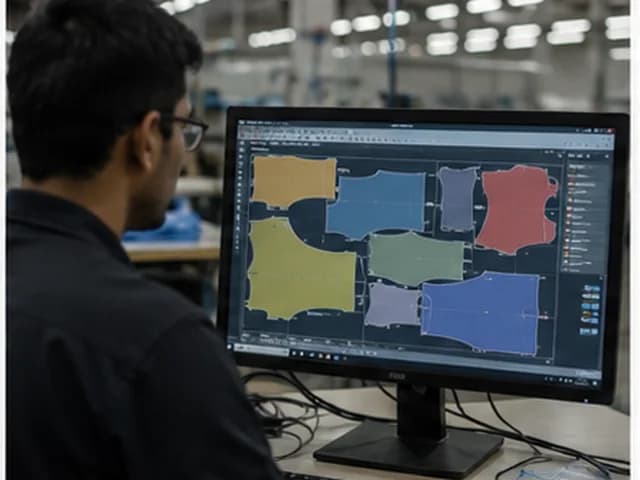
Marker efficiency is the share of a fabric roll that ends up in garments rather than in the waste bin. It is set by how pattern pieces are laid out before cutting. A skilled marker maker gets good results. An optimiser searches thousands of layouts, far more than a person can. It does that on the hundredth order of the week as consistently as on the first.
The gain sounds small. It is not. Fabric is most of your material cost, so a point or two of marker efficiency across a season is real money. Unlike most improvements it also asks for no change on the floor. The cutting master's job stays the same, and the cut plan they receive is simply better.
What it needs
- Digital pattern files. If your patterns are manual, digitising them is the first project, and it takes weeks.
- Fabric width and usable width. These are not the same, and the gap matters.
- Size ratio per order, so the marker matches the mix you actually cut.
- Directional and matching constraints. Stripes and checks change everything.
Automated Fabric Inspection
Catch defects on the roll. After cutting, the same defect costs many times more to deal with.
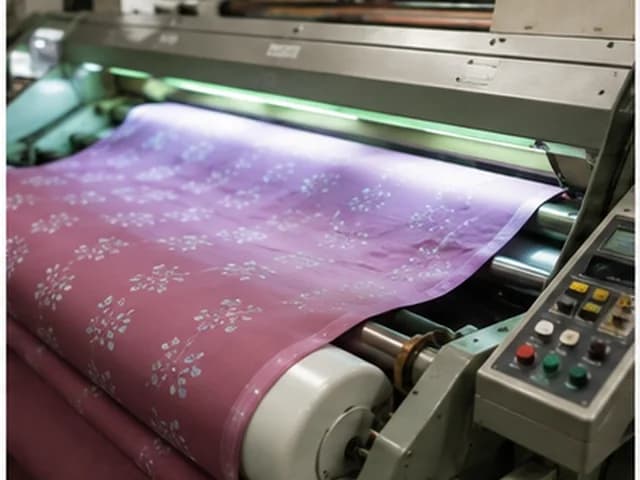
Most units grade fabric by the four-point system on a sample of rolls. Checking every roll by eye takes hours nobody has. So defects reach the cutting table. By then the fabric, the labour and the time behind them are already spent.
Camera-based inspection runs across the full width and length of every roll. It sorts defects by type and records where each one sits. Two things follow. The cut plan can route around known defect positions. You also build an evidence trail for supplier claims, which turns an argument with a mill into a record.
Practical notes
- Lighting and roll tension must stay steady. If they drift, the system reports faults that are not there.
- Knits and wovens need separate training. One model does not cover both.
- Defect position data is what lets the cut plan route around faults.
- The supplier evidence trail is often worth more than the detection itself.
Order Delivery Risk Prediction
Know an order is slipping weeks out, while you can still do something other than air freight.
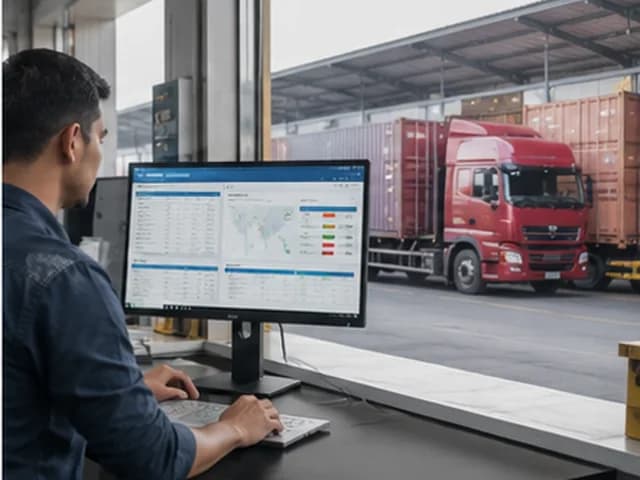
A late shipment is almost never a surprise on the day. The signals show up weeks earlier: a sampling round that ran long, fabric that came late, a line running below the planned efficiency. Nobody watches those three together. So the problem lands when the ship date is a fortnight away, and air freight is the only fix left.
A risk model watches these signals every day across every live order, and flags the ones drifting away from the pattern that has ended in on-time shipment before. Early warning is the whole value. At six weeks you can resequence, add a line or renegotiate. At one week you can only pay.
Signals that matter
- Sampling round count and days elapsed against plan.
- Fabric receipt date versus committed date, per supplier.
- Line output per day against the efficiency assumed in costing.
- Order size against what this unit has delivered on time before.

Style-Level Demand Forecasting
Forecast a new style from what it is made of, not from what it sold.
The hard part in apparel is that the thing you most need to forecast is new. A style launching this season has no sales history, not one week of it. Normal forecasting has nothing to work with, so the buy falls back on a merchandiser's judgement.
Attribute-based forecasting works another way. It learns how past styles sold, grouped by fabric, silhouette, price band, colour family and sleeve length. A new style is then read from those same attributes. It will not beat a merchandiser on a category they know well. It helps most across a wide range, where nobody can hold every style in their head.
Depends entirely on
- A consistent product attribute master. This is the whole project, and it is usually messy.
- Sales history at style, colour and size level, not category totals.
- Markdown records, so a style that sold at 50% off is not counted as a success.
- Enough past styles to learn from. A few dozen is not enough.
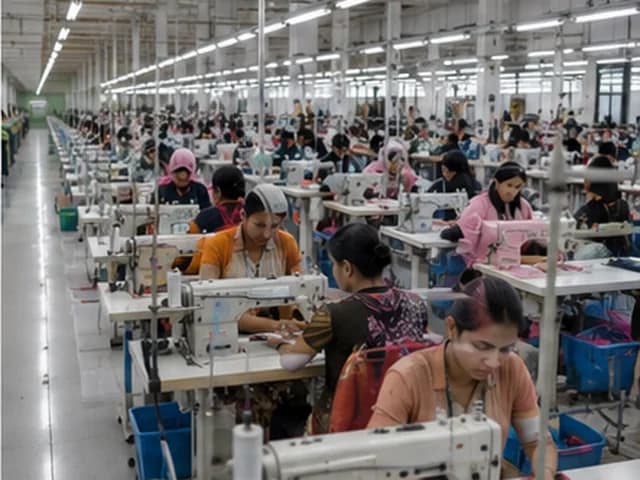
Production Line Balancing
The line runs at the speed of its slowest operation. That operation moves.
Balancing a line means spreading work across operators so no station becomes a bottleneck. An industrial engineer sets it at style changeover, using standard times and years of their own experience. On day one it is usually about right.
It stops being right within a day or two. Operator skill varies, some pick up a new operation faster than others, and absence on any given day reshuffles the plan. A model can use cycle times observed on the day instead of standard times, and suggest a rebalance during the run. The gap between standard and actual times is often wider than anyone assumes.
Needs
- Actual cycle times per operation and per operator, not standard minute values.
- An operator skill matrix, showing who can run which operation.
- Hourly output by station, not one total for the day.
- An industrial engineer who will act on it. This gives suggestions, not orders.
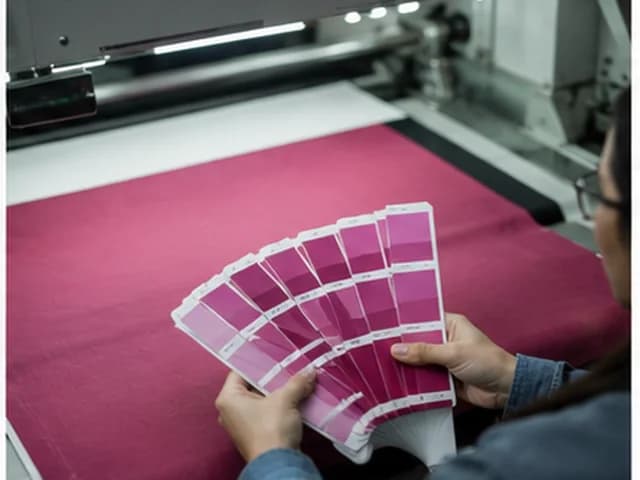
Shade Matching & Colour QC
Catch shade variation between batches, before it turns into a discount.
Shade is judged by eye under a light box. Human colour judgement drifts through the day, with fatigue, with room light and with the person doing the judging. Variation missed at fabric stage becomes a garment problem. A buyer who finds shade variation across a shipment will discount it or reject it.
An instrument gives one number per batch. It compares that number against the approved standard and flags drift while the roll is still fabric. It also builds a dyeing record by supplier and by lot. That record is the evidence you need when a mill disputes a claim.
Notes
- Calibrated measurement matters more than the model. This is instrumentation first.
- Buyer tolerance varies. The standard has to be theirs, not a generic one.
- Record by lot and by supplier to build the consistency history.
- Catch it at fabric stage. After cutting, every option is expensive.

Vendor Performance Scoring
Rank suppliers on what they deliver, not on what they quote.
Fabric and trim suppliers are picked on price and relationship, with delivery performance held as an impression rather than a number. Everyone knows which supplier is unreliable. Almost nobody can say by how much, or what that unreliability costs them over a year.
Score them on delivery variance, quality rejection rate and reply speed. The impression turns into evidence that prices the cheap supplier who is late. Take one who is three percent cheaper but whose lead time swings by two weeks. The air freight and the chasing that swing causes downstream can cost you far more than the saving.
Score on
- Delivery date variance, not average lead time. Variance is what breaks a plan.
- Quality rejection rate at inward inspection.
- Shade and lot consistency across repeat orders.
- Responsiveness on queries and claims. It predicts behaviour when something goes wrong.

Assortment Planning
Set the channel and the size ratio from evidence, not from an even split.
Size ratios and channel splits are usually set by habit: one standard ratio across every style, an even split across channels. The result is easy to predict. Some sizes sell out in the first week while others are marked down at the end of the season. Both happen for the same reason.
Model size demand and channel demand on their own, per style and per location, and the ratio then reflects who actually buys where. This matters more to domestic brands and retailers than to pure export units. For them it is usually the largest single markdown saving they can make.
Most relevant if
- You sell domestically across multiple stores or channels.
- Size-wise markdown is a recurring end-of-season cost.
- Regional size profiles genuinely differ across your locations.
- Less relevant for pure export units working to buyer-specified ratios.
Where We Specialise
Agents for the Chasing
An apparel merchandiser's day is chasing. Chasing a buyer for sample approval, a mill for fabric, a supplier for a test report, an internal team for a status nobody has updated. The work is not hard and it never stops, and in most units it eats more senior hours than anything else.
The four agents below do the chasing and the assembling. A person still decides what to say to a buyer, and what to accept from a supplier. They just start from a current picture, instead of spending the morning building one.
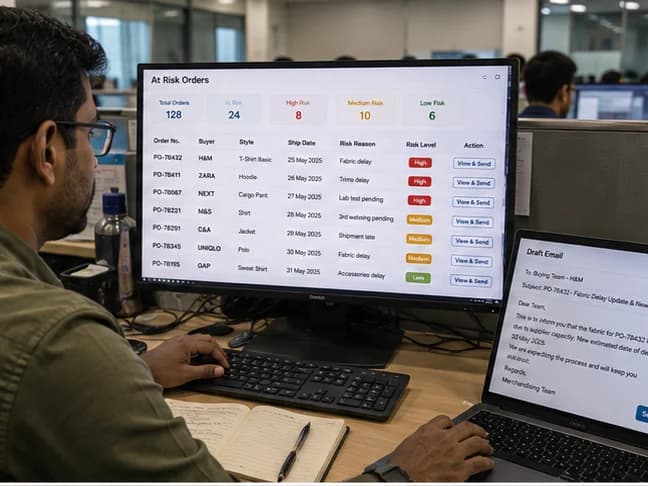
Order Follow-Up Agent
Every live order tracked against its critical path, with chases drafted before anything slips.
A merchandiser runs many orders at once, each with its own critical path: sample approval, fabric in-house, cutting start, ship date. Holding all of that in view is a full-time job, and nobody is given it as one.
The agent tracks each order against its plan every day and marks which milestones are close or already missed. Then it drafts the chase: a buyer chase for a pending approval, a supplier chase for late fabric, an internal note for a line running behind. What reaches the merchandiser is a ranked list with messages ready to send.
They edit and send. How hard to push a particular buyer stays entirely their call.
What it watches
- Sample submission and approval dates against the critical path.
- Fabric and trim receipt against committed dates.
- Cutting and production start against plan.
- Whether the ship date still works, given actual line output.
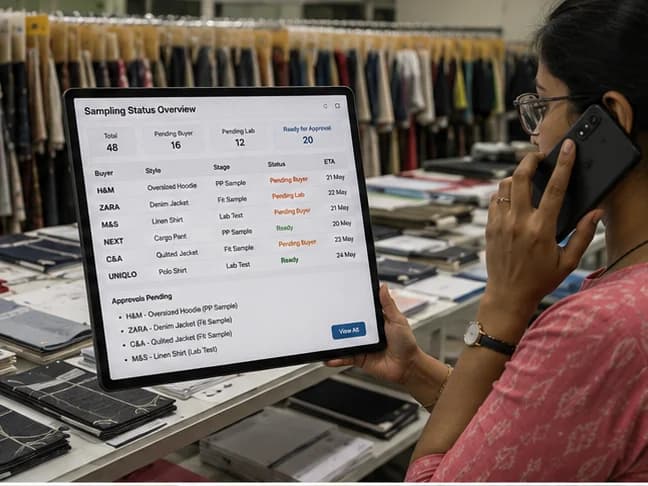
Sampling Coordination Agent
Sampling status across every buyer, in one place, current.
Sampling is where orders quietly lose weeks. Many rounds, many buyers, each with comments arriving by email and each waiting on somebody. The status sits across inboxes and a whiteboard, and pulling it together takes half a day.
The agent holds that picture in one place: which samples sit with which buyer, and how many days each has been pending. It also tracks which comments have arrived and not been acted on. It flags which ones are close to putting the ship date out of reach. It drafts reminders for the ones running days overdue.
Most of the value is simple. You see the delay while it is still a week, not a month.
Where it pays
- Units running many buyers, each with its own sampling protocol.
- Sample comments arriving by email and never centrally logged.
- Approvals that stall and are noticed only when production should have started.
- It links sampling delay to ship-date risk. That is the argument that moves a buyer.
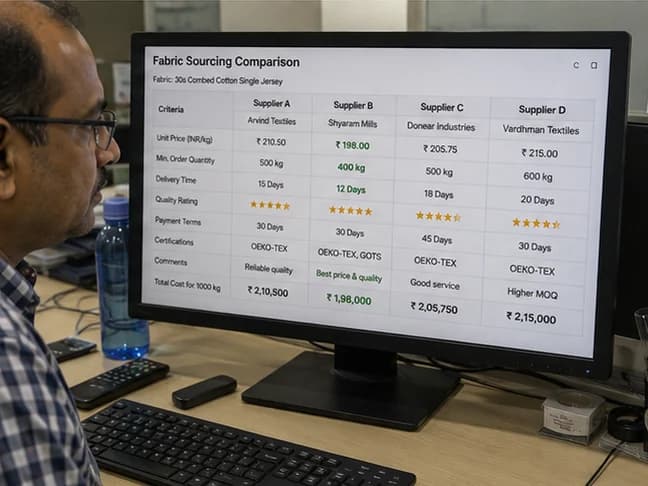
Fabric Sourcing Agent
Quotes gathered, compared on true landed cost, and chased without being reminded.
Sourcing a fabric means sending one specification to several mills, then waiting for quotes that come back over days in different formats. You compare them on price per metre. That is not the number that matters.
The agent sends the enquiry, collects the replies and puts them into one common form. It then shows true landed cost: freight, duty, minimum order quantity and the supplier's past delivery variance. It chases quotes that have not come in. It flags a quoted lead time that does not match what the mill has actually delivered.
The sourcing decision stays with a person, and it rests on relationships an agent knows nothing about. The gathering and the sorting do not.
Compares on
- Landed cost, not quoted price per metre.
- Minimum order quantity against your actual requirement.
- Past delivery variance for that mill, from your own records.
- Quality rejection history, which rarely enters the quote comparison.
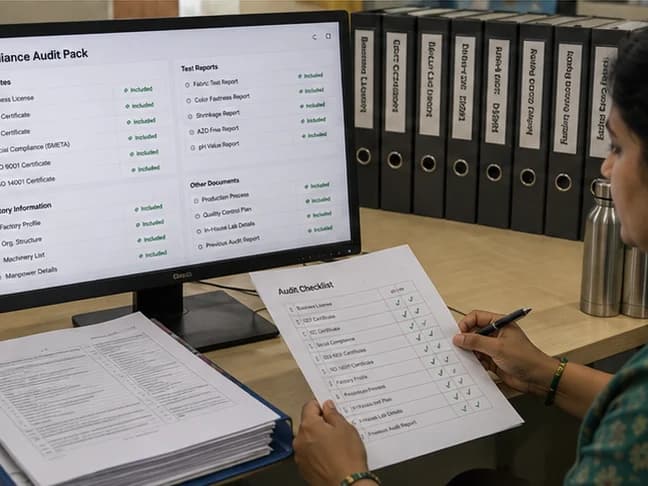
Compliance Document Agent
The audit pack assembled and gap-checked before the buyer's auditor arrives.
Buyer audits — social, technical, environmental — need a huge document pack. The pack is scattered and always a little out of date. Certificates run out of date, test reports sit in email, and training records live in a register. Pulling it all together takes weeks, and a missing document becomes a non-conformance even where the practice behind it was sound.
The agent keeps the pack current. It tracks certificate expiry and collects test reports as they arrive. It flags gaps against each buyer's own checklist, and builds the submission in the format that buyer wants. It warns you weeks before a certificate expires, not after an auditor finds it.
This makes a compliance officer's job possible rather than replacing it. The judgement on a finding stays theirs; the assembly and the calendar do not need a person at all.
Tracks
- Certificate and licence expiry, with the warning before, not after.
- Test reports against each buyer's required standards.
- Training and grievance records where the audit protocol requires them.
- Buyer-specific checklists, since no two are identical.
Sequencing
Which to Start With
Ordered by how fast a typical export unit sees something it can act on.
| Use case | Data usually ready? | Time to first result | Start here if |
|---|---|---|---|
| Order Delivery Risk | Yes — dates already recorded | 6–8 weeks | Air freight is a recurring cost |
| Vendor Performance Scoring | Yes — in purchase records | 4–6 weeks | Suppliers are chosen on price alone |
| Marker Optimisation | Needs digital patterns | 8–12 weeks | Fabric cost dominates your sheet |
| Line Balancing | Needs hourly, not daily, output | 8–12 weeks | Efficiency varies without explanation |
| Fabric Inspection | Needs a camera rig | 3–4 months | Defects are found after cutting |
| Style Forecasting | Needs a clean attribute master | 3–5 months | You buy for a domestic range |
Being Straight About It
Worth doing if
- Export units where late shipments turn into air freight more than occasionally
- Units where fabric is the main material cost and markers are made by hand
- Units already recording hourly output and inspection results in some form
- Enough order volume that one point of marker efficiency is real money
Probably not, if
- Very small units where the owner sees every order and every roll in person
- Units with no digital patterns, unless digitising them is accepted as the first project
- Job-work units with no control over fabric, styles or delivery commitments
- Anyone expecting a model to fix a capacity problem that is genuinely a capacity problem
FAQ
Questions Exporters Ask Us
Partly, and it depends which project. Delivery risk and vendor scoring need dates and quantities. Those usually sit in your ERP, or at least in purchase and shipment records. Line balancing needs hourly output per station, and if that lives only in a register it must be digitised first. That is typically a few weeks of work. It is worth doing anyway, since you cannot manage variation you cannot see. We would rather scope that honestly than find it in month two.
We will not quote you a number, and be wary of anyone who does before seeing your patterns. It depends on how your markers are made today, on your fabric widths, and on whether you cut directional or matched fabrics. What we can do is run your recent markers through an optimiser so you see the gap on your own orders. That takes days, and it beats a figure from someone else's case study.
Digitising them is the first project, and it is a real cost. Expect a few weeks, depending on how many active blocks you hold. It is worth doing on its own merits, since digital blocks make grading, storage and reuse far easier. We would rather quote it as a separate phase than hide it inside a proposal and surprise you later.
Yes, though not with the same models. Fabric inspection needs separate training for knits and for wovens, since the defect types differ and the surfaces behave differently. Marker optimisation handles both, but the constraints are not the same. If you run both, expect the project to take them one after the other rather than assuming that one transfers to the other.
Rarely in a direct way, and that is usually fine. Buyer portals are mostly closed, so we work from your side: your ERP, your production records, and the emails and files buyers send. Where a buyer gives a data feed we use it. Where there is none we read what they send you, which removes a re-keying step that eats a merchandiser's day.
Delivery risk, vendor scoring and forecasting are cheap to run: they are small models on a schedule, often once a day. Fabric inspection costs more, since it runs all day and needs a rig. Agents use a large language model, and that carries a cost per action which scales with how many orders and buyers you run. A unit with forty live orders costs more than one with eight, so we price against your real volumes before you commit.
More than most vendors admit. Expect your industrial engineer, your merchandising head or your QA manager to give several hours a week, heaviest during assessment and validation at the start. That is not overhead. It is what makes the model fit your unit rather than a textbook apparel plant. A project where nobody inside has time will produce something nobody uses.
The paperwork side, a great deal: it tracks expiry, assembles packs, and checks against each buyer's protocol before an auditor finds the gap. What it cannot do is make a non-compliant practice compliant. If the real issue is a gap in working conditions or in environmental practice, that is a management problem and no software fixes it. We say so plainly.
Less of it, honestly. Line balancing and fabric inspection apply if you control those steps. Forecasting, assortment planning and sourcing usually do not, since whoever gives you the order makes those calls. Delivery risk still helps if you are held to dates. We would rather say the scope is narrow for your model than sell you eight use cases where two apply.
Model them together and compare them, which is usually worth more than modelling each one alone. Line balancing and delivery risk work per unit, but the comparison across units is where the value sits. Why does one deliver on time and another not, on similar orders? That question often exposes process gaps nobody had isolated. It needs consistent recording across sites, which is sometimes the first job.
Usually yes. You need a calibrated spectrophotometer if you do not already have one. This is instrumentation first and modelling second, and we will say so plainly. Most of the value comes from measuring by instrument rather than by eye. The models add drift between batches and supplier consistency tracking on top of that.
Your data is yours, and you can export it at any time. We will never hold it hostage. You get the working system, the documentation, and training so your team can run it day to day. What else transfers at the end of a project — model artefacts, source, licence terms — is set out in the contract before work starts. There are no surprises either way. Your patterns and your supplier history are commercially sensitive, and they should never sit anywhere you cannot control.
Vendor scoring, four to six weeks. Delivery risk, six to eight weeks. Marker optimisation, eight to twelve weeks if your patterns are already digital, and longer if they are not. Fabric inspection, three to four months, including the rig and the trial. Anyone promising a live fabric inspection system in a month has not asked how many defect samples you can supply.
Then we say so, and that has happened. Sometimes the recording is not there yet, and the sensible first step is to record properly for one season. Sometimes the problem is a capacity limit that no optimisation touches. A short piece of work that ends with you not spending money beats a long one that ends in software nobody opens.
Recognise your plant in any of that?
Tell us which problem is costing you most and we will tell you honestly whether it is worth building, what data it needs, and roughly what it costs.
Book a Free ConsultationSee our Textile & Apparel solutions